Why LLMKIT: sharing what works across five stacks
- Why LLMKIT: sharing what works across five stacks
- Context is the hard part
- The fourth and fifth stack
- The boring 20% that made it stick
- One view across Claude Code, Codex and Copilot
- Copy, never move
- Normalize once, at the end
- Windows 11, and an honest scorecard
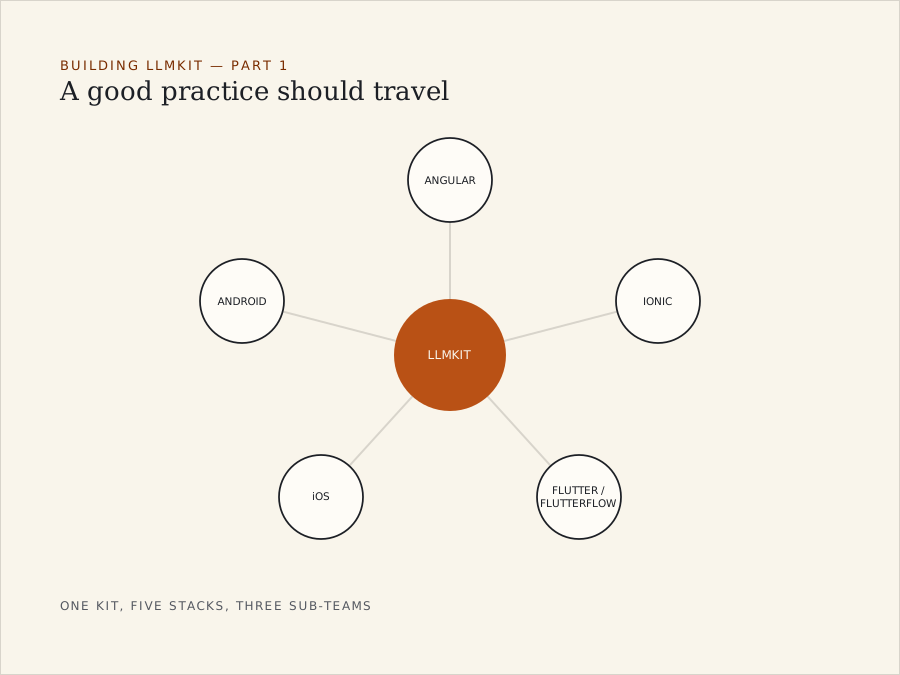
I’ve been leading COE UI — the Centre of Excellence UI team at Jocata — for almost four years. It spans Angular, Ionic, Flutter/FlutterFlow, native iOS and native Android: five very different stacks, five very different codebases, three sub-teams.
A few months ago one problem kept nagging at me.
The gap wasn’t the tools
Every engineer on the team had access to AI coding assistants. What they didn’t have was a shared way of using them. Each person was working out prompting, context and guardrails on their own — and when someone in one sub-team found something that worked, it stayed in that sub-team.
On a single-stack team that’s a nuisance. On a five-stack team it’s expensive. A trick an Angular engineer discovers for giving the assistant the right context doesn’t automatically carry over to an iOS repo, because the codebase, the conventions and the idioms are all different. Without a shared mechanism, every sub-team pays the same learning cost separately, and the best practices never compound.
We had the tools. We didn’t have a way to share what worked across all five.
What LLMKIT is
That itch became LLMKIT: a distribution kit for AI-assisted development across a multi-stack team. It isn’t another assistant. It packages the setup, the context and the practices that make the existing assistants useful, and installs them consistently in every stack — so a practice that works can be written down once and reach everyone.
From the start, a few goals shaped it:
- Every stack, not just mine. It had to help all five stacks, not only the one I happen to be closest to.
- Consistent, but idiomatic. The same underlying system everywhere, while still respecting how each stack actually works.
- Distributed, not documented. A practice that lives on a wiki page and has to be set up by hand doesn’t spread. One that arrives with the kit does.
A live build
LLMKIT is very much a live build, not a finished case study. This series follows it milestone by milestone — the context problem, going multi-stack, the unglamorous parts that made it stick, and the usage-history layer that followed.