One view across Claude Code, Codex and Copilot
- Why LLMKIT: sharing what works across five stacks
- Context is the hard part
- The fourth and fifth stack
- The boring 20% that made it stick
- One view across Claude Code, Codex and Copilot
- Copy, never move
- Normalize once, at the end
- Windows 11, and an honest scorecard
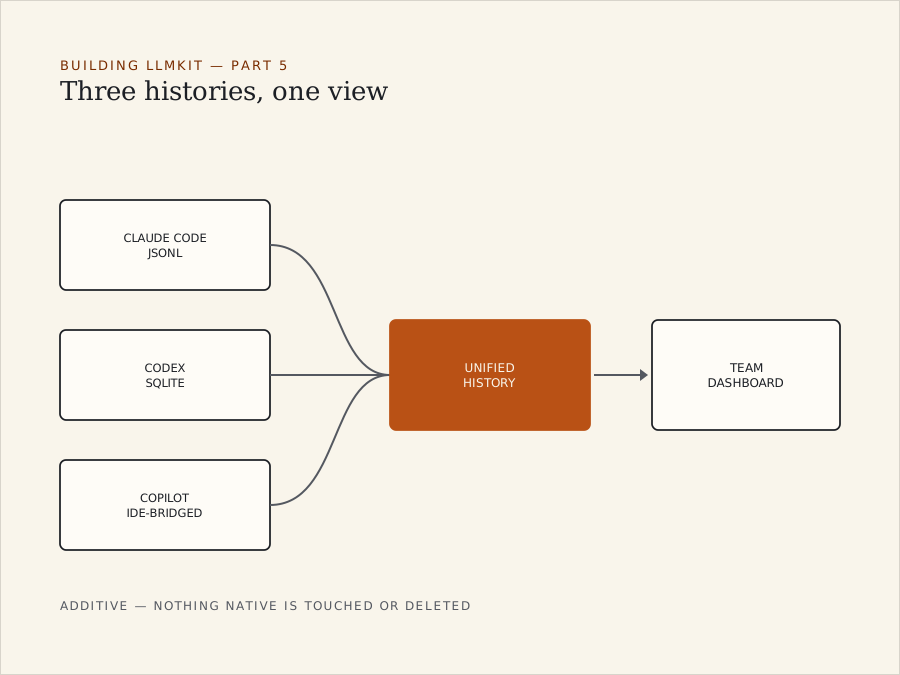
One gap became obvious once our team started using more than one AI coding assistant.
Three assistants, three silos
Claude Code, Codex and GitHub Copilot each keep their own usage history — in their own format, in their own corner of the filesystem. JSONL here, SQLite there, and none of it talking to the others.
That’s fine if you only care about one assistant. It isn’t fine if you’re trying to understand how a whole team is actually using AI-assisted development, day to day.
What we built
LLMKIT now includes a layer that reads all three natively — from wherever each one actually stores its history — and merges them into one provider-agnostic view:
- Daily usage snapshots
- Prompt records
- A single consolidated feed
All in one place instead of three.
What it unlocks
That feed powers a consolidated dashboard. Instead of checking three tools separately, we get one view of how the team is using AI-assisted development: who is using what, how often, and where adoption is still thin.
“Where adoption is still thin” is the useful part. It tells me which sub-team or stack needs help next — which is the whole reason LLMKIT exists.
Additive, not risky
The design choice I like most is that it’s additive. Nothing native gets touched or deleted; the unified layer is derived on top of what each assistant already writes. It’s a small choice, but it’s the difference between “we have data” and “we can actually see anything.”
The next two parts go deeper on how the layer is built: how the history moves safely, and how three incompatible formats become one.