Shippable, with findings
- Why LLMKIT: sharing what works across five stacks
- Context is the hard part
- The fourth and fifth stack
- The boring 20% that made it stick
- One view across Claude Code, Codex and Copilot
- Copy, never move
- Normalize once, at the end
- Windows 11, and an honest scorecard
- Shippable, with findings
- Mirror, don't ask
- A name isn't enough
- A footer means it finished
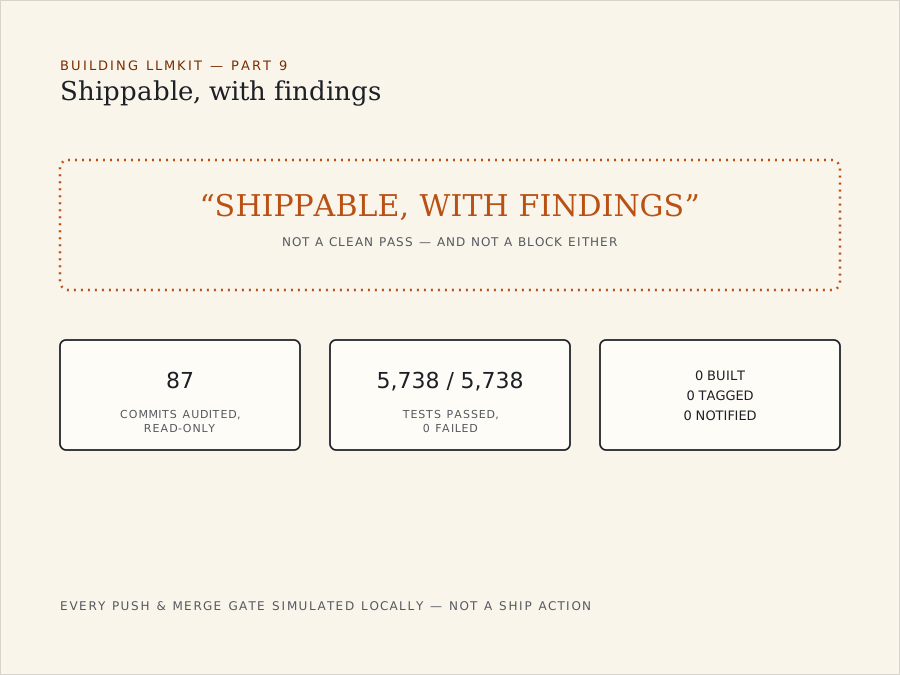
Before LLMKIT’s last release shipped, it went through an audit that built nothing, bumped nothing, tagged nothing, and notified nobody.
The audit
A release-readiness audit runs read-only against everything since the last release — in this case 87 commits — and answers one question: is this actually safe to ship, without doing anything a ship would do.
- The full test suite ran: 5,738 passed, 0 failed.
- Every push and merge gate we enforce got simulated locally, rather than tested by actually pushing.
- The script that builds and tags the release exists too, and deliberately didn’t run during the audit — running it would have been a release action, not a check.
The verdict
It wasn’t a clean pass. It was “shippable, with findings.”
We shipped anyway. The findings were real but non-blocking, and the audit’s job is to surface that distinction rather than force a binary go/no-go.
Why it matters
A release process that can only say pass or fail throws away the most useful information it has — whether the issues it found are the kind that should stop a release, or just the kind worth a follow-up ticket. “Shippable, with findings” keeps that distinction instead of flattening it.